Connecting nPorts
Constructors such as nP.R(), nP.L(), and nP.Tee() return nPort objects. Connect those objects to make a larger circuit, then call .out() on the result. Set the analysis frequencies before creating the components.
Choose a connection method
| Method | Use it for |
|---|---|
nP.nodal(...connections) | Circuit wiring, shunt branches, junctions, and multiport networks. |
nP.cascade(first, second, ...) | A chain of two-port stages in signal-flow order. |
first.cas(second) | Cascading exactly two two-port nPorts; returns a new nPort and can be chained. |
Each method returns an nPort with the combined S-parameters. The result also carries the combined noise and any compatible attached signal or known intermodulation sources. See Noise and Intermodulation for those measurements.
Shape groups for schematics
When a network will be drawn, you can place shape names around its connection rows. The final result is still one nodal nPort:
// Two shaped sections, one nodal analysis
nP.global.fList = [2e9];
var r1 = nP.R(75);
var r2 = nP.R(50);
var c1 = nP.C(1e-12);
var network = nP.nodal(
  {series: [
    [r1, 1, 2],
    [r2, 2, 3]
  ]},
  {series: [
    [c1, 3, 4],
    [r1, 4, 5]
  ]},
  ['out', 1, 5]
);
nP.schematic(network);
Shape names guide the drawing; the node numbers determine connectivity. Repeated names use separate objects. A component can be reused across groups because each row records its own occurrence. The existing flat syntax remains supported, and both forms use the same electrical matrices. Optional signal options still follow the output row.
See Schematics for the shape vocabulary, series–ladder–series workflow, independent detection results and current composition limits.
Wire components with nodal()
Give each component one connection label for each of its ports, in that component's port order. The final ['out', ...] entry lists the labels to expose as ports on the resulting circuit.
nP.global.fList = nP.global.fGen(100e6, 2e9, 51);

var r1 = nP.R(25);
var l1 = nP.L(2e-9);

var circuit = nP.nodal(
    [r1, 1, 2],
    [l1, 2, 3],
    ['out', 1, 3]
);

var response = circuit.out('s11dB', 's21dB');
nP.lineChart({inputTable: [response], title: 'Series R-L response'});
Here, label 2 joins port 2 of r1 to port 1 of l1. Labels 1 and 3 become the circuit's external ports 1 and 2. The labels are identifiers, not voltages; their numeric size has no electrical meaning.
Use each label exactly twice across the component entries and the out entry. An internal label joins two component ports. An external label joins one component port to one out port. To join three or more branches, add an explicit junction such as nP.Tee() rather than putting the same label on three component ports.
Add a shunt branch
nP.Tee() is an ideal three-port junction. Its port 1 is the common or shunt branch; put that label first in the Tee entry. A shunt component normally leads to nP.Short().
nP.global.fList = nP.global.fGen(100e6, 2e9, 51);

var tee = nP.Tee();
var short = nP.Short();
var r1 = nP.R(25);
var c1 = nP.C(3.17e-12);

var lowPass = nP.nodal(
    [r1, 1, 2],
    [tee, 4, 2, 3],
    [c1, 4, 5],
    [short, 5],
    ['out', 1, 3]
);

var response = lowPass.out('s11dB', 's21dB');
nP.lineChart({inputTable: [response], title: 'RC low-pass'});
The Tee's port 1 connects to c1 at label 4. The capacitor's other port connects to the short at label 5. Labels 1 and 3 are the external input and output.
Set the resulting port order
The order of labels after 'out' becomes the port order of the returned nPort. For example:
nP.global.fList = nP.global.fGen(1e9, 3e9, 21);

var tee = nP.Tee();
var branch1 = nP.Tlin(50, 0.0254);
var branch2 = nP.Tlin(50, 0.0254);

var divider = nP.nodal(
    [tee, 1, 2, 3],
    [branch1, 2, 4],
    [branch2, 3, 5],
    ['out', 1, 4, 5]
);
The result is a three-port: label 1 is port 1, label 4 is port 2, and label 5 is port 3. divider.out('s21dB', 's31dB') reports transmission from input port 1 to each output branch. For coupled lines such as Tclin() and mclin(), supply connection labels in their published port order: 1 at upper left, then 2, 3, and 4 clockwise.
Cascade two-port stages
nP.cascade() connects two-port nPorts from left to right. The output of one stage feeds the input of the next.
nP.global.fList = nP.global.fGen(1e9, 5e9, 21);

var line1 = nP.Tlin(50, 0.0127);
var line2 = nP.Tlin(60, 0.0254);

var chain = nP.cascade(line1, line2);
var response = chain.out('s11dB', 's21dB');
For two stages, line1.cas(line2) produces the same connection. cas() returns a new nPort, so line1.cas(line2).cas(line3) is also possible. Use nodal() when the circuit has a shunt branch or more than two external ports.
Reuse a completed circuit
A network returned by nodal() or cascade() is itself an nPort. You can connect it as a building block in another network. Give it one label per exposed port, in the order chosen by its original out entry.
nP.global.fList = nP.global.fGen(100e6, 2e9, 51);

var r1 = nP.R(25);
var l1 = nP.L(2e-9);
var stage = nP.nodal(
    [r1, 1, 2],
    [l1, 2, 3],
    ['out', 1, 3]
);

var attenuator = nP.Attn(3);
var complete = nP.cascade(stage, attenuator);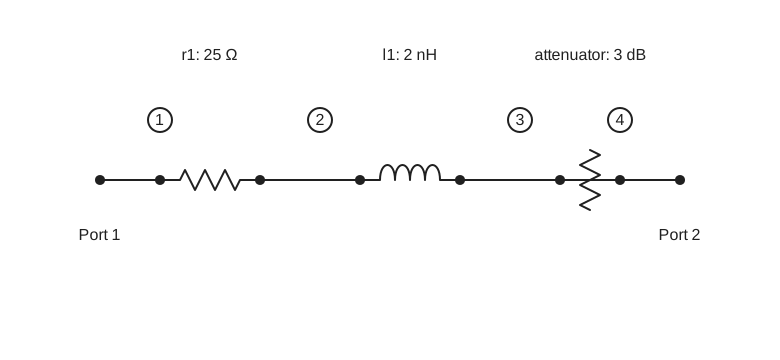
Keep analysis settings aligned
Components in the same connection must have the same frequency rows in the same order. nodal() and cascade() reject mismatched rows; they do not interpolate. Build connected components with matching fList values and the same reference impedance Ro. Set two-tone analysis before constructing all stages if the network needs intermodulation products.
For a sampled digital source or VNA-time, select a valid nP.global.tList before nP.mod(); sampled modes need one time per generated waveform sample. The analog modes also currently require a valid time list, although they construct sparse tone frequencies. VNA-frequency uses fList and requires no tList. Create the source before its frequency-dependent components, then attach {signal: tx} as the final argument to nodal() or cascade(). The Tutorial shows the sampled-signal sequence.